 "Food statistics 2026")
Places where more people play sports or stay active tend to have lower obesity levels, even if there are lots of fast-food outlets around. Being active really does make a difference.
Food shapes everything
Not only our health, but also our economy, environment, and communities. In recent years, the UK’s relationship with food has undergone significant change, including shifts in lifestyles, global supply chains, and growing awareness of nutrition and sustainability.
Understanding the data behind what, how, and why we eat provides vital insight into the nation’s wellbeing.
Our food statistics report explores key insights, from eating habits and dietary choices to food inequality, fast food consumption, and industry production trends.
Whether it’s the rise of plant-based diets, the growing reliance on food banks, or the changing landscape of supermarkets and restaurants, there’s a clear picture of the opportunities and challenges shaping the nation’s plate for 2026 and beyond.
Top ten food statistics for 2026
Most of us feel we could be eating better: Only about 1 in 13 people in the UK say their diet is “very healthy” as of December 2025.
Nearly three-quarters of adults in Britain eat meat, while only a small minority avoid it - 7% are vegetarians and plant-based/vegan, as of 2026.
7.5 million individuals in the UK are from households struggling to afford enough food, a figure that’s jumped sharply (79%) since the pandemic.
London has far more fast-food outlets than anywhere else in the country, with around 50% more per person than the South East, which has the lowest.
There are over 19,000 supermarkets in the UK, and about 1 in 5 is run by the Co-operative Group.
Nearly 3 million people relied on food banks in 2023/24, a figure that continues to rise year-on-year.
2.17 million children in England now qualify for free school meals, nearly double (90%) the number eligible ten years ago.
The UK buys far more food from abroad than it sells - we import over £53 billion worth of food but export only £15 billion, making us heavily reliant on imports and giving us a trade deficit of 77.81%.
Most food manufacturers in the UK are small businesses. Huge manufacturers (500+ employees) exist, but they make up less than 1% of all food-producing companies.
British eating habits data and insights
As of January 2026, nearly three-quarters of British adults would class themselves as meat eaters, while one in 20 follow a vegetarian diet.
 "Dietary choices of British adults over time")
Dietary choices of British adults over time
Note: Figures may not add up to 100% due to source rounding.
(Source: YouGov)
The percentage of meat eaters fell from 73% in 2019 to 68% in 2021, illustrating the impact the COVID-19 pandemic had on British eating habits. In line with this, the proportion of Brits following vegan, vegetarian, and flexitarian diets each increased by at least one percentage point over the same period.
As people were required to work from home, Brits had more time to experiment with dietary choices, leading to this initial decrease in the proportion of meat eaters. However, these changes in dietary choices have since reversed, as the proportion of meat eaters has risen back to 73%, with Brits having less time to cook at home.
| Dietary choise | July 2019 | July 2020 | July 2021 | July 2022 | July 2023 | July 2024 | July 2025 | January 2026 |
|---|---|---|---|---|---|---|---|---|
| Plant-based/vegan | 2% | 2% | 3% | 2% | 2% | 3% | 2% | 2% |
| Vegetarian | 5% | 6% | 7% | 5% | 5% | 6% | 5% | 5% |
| Flexitatian | 13% | 13% | 14% | 16% | 14% | 13% | 13% | 13% |
| Pescaratian | 3% | 3% | 3% | 3% | 3% | 3% | 3% | 2% |
| Meat eater | 73% | 72% | 68% | 70% | 72% | 72% | 74% | 73% |
| None of these | 3% | 4% | 4% | 4% | 4% | 3% | 3% | 4% |
Dietary requirements of Brits
According to the latest food statistics, one in 20 British adults are dairy-free. This dietary requirement can be informed by choice (i.e. among vegans), but it’s also a consequence of a range of health issues, such as lactose intolerance or irritable bowel syndrome.
Note: Figures may not add up to 100% as more than one option could be selected.
(Source: YouGov)
The proportion of Brits who are sugar- or nut-free has remained fairly stable over the past seven years, with 1% and 6% of adults, respectively, following these dietary requirements as of January 2026.
Dietary requirements of British adults over time
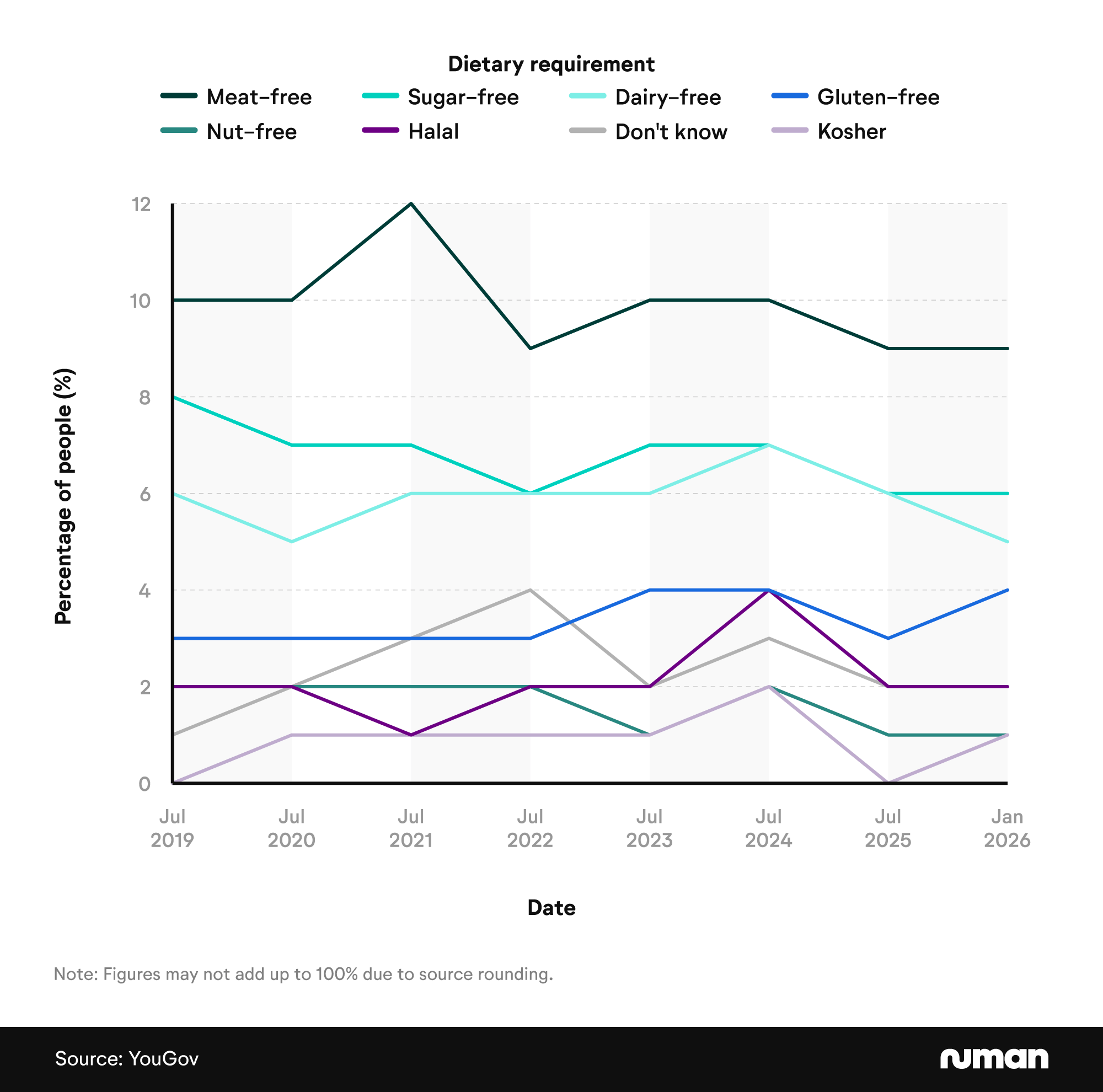
| Dietary requirement | July 2019 | July 2020 | July 2021 | July 2022 | July 2023 | July 2024 | July 2025 | January 2026 |
|---|---|---|---|---|---|---|---|---|
| Dairy-free | 6% | 5% | 6% | 6% | 6% | 7% | 6% | 5% |
| Gluten-free | 3% | 3% | 3% | 3% | 4% | 4% | 3% | 4% |
| Halal | 2% | 2% | 1% | 2% | 2% | 4% | 2% | 2% |
| Kosher | 0% | 1% | 1% | 1% | 1% | 2% | 0% | 1% |
| Nut-free | 2% | 2% | 2% | 2% | 1% | 2% | 1% | 1% |
| Sugar-free | 8% | 7% | 7% | 6% | 7% | 7% | 6% | 6% |
| Meat-free | 10% | 10% | 12% | 9% | 10% | 10% | 9% | 9% |
| None of these | 73% | 74% | 73% | 74% | 74% | 71% | 76% | 77% |
| Don't know | 1% | 2% | 3% | 4% | 2% | 3% | 2% | 2% |
How healthy do Brits think their food choices are?
Just 8% of British adults would classify their eating habits as very healthy, as of December 2025.
This figure fell from 10% to 7% in September 2021, despite the COVID-era rise in dietary choices that are often associated with healthier eating, such as flexitarianism and veganism.
 "Food stats 3")
Brits' opinions on their food
Note: Figures may not add up to 100% due to source rounding.
(Source: YouGov)
Around one in 20 British adults believes their diets aren’t very healthy at all, while a quarter would class their eating habits as not very healthy.
Interestingly, 2% of adults state that they don’t know how healthy their eating habits are, indicating a lack of understanding around dietary choices.
Food noise, the intrusive thoughts that encourage you to eat even when you aren’t physically hungry, can affect how healthy our diets are. Numan reports that 84% of UK adults experience food noise, with 44% struggling to resist cravings - a figure which increases to 70% among those who are overweight or obese.
| Opinion | October 2019 | September 2020 | September 2021 | September 2022 | September 2023 | September 2024 | September 2025 | December 2025 |
|---|---|---|---|---|---|---|---|---|
| Very healthy | 9% | 10% | 7% | 8% | 7% | 10% | 10% | 8% |
| Fairly healthy | 62% | 62% | 60% | 61% | 61% | 60% | 61% | 59% |
| Not very healthy | 23% | 22% | 24% | 23% | 26% | 23% | 23% | 25% |
| Not very healthy at all | 5% | 4% | 6% | 5% | 5% | 5% | 5% | 6% |
| Don't know | 2% | 2% | 3% | 3% | 2% | 2% | 2% | 2% |
Factors influencing food choices
As of August 2025, the food factors impacting the greatest proportion of adults’ diets are sugar levels, fat content, and calories. Over a quarter of Brits state that these three nutritional qualities influence the choices they make when picking food at home or when eating out.
 "Food stats 4")
Factors influencing food choices of British adults over time
Note: Figures may not add up to 100% as more than one option could be selected.
(Source: YouGov)
However, these figures represent a significant drop from September 2019. Nearly two-fifths of British adults took into account their sugar consumption when making food choices, while 36% and 30% stated they paid attention to the fat content and calories within their food, respectively.
In fact, all factors influencing food choices have decreased in popularity since 2019, except for two. The proportion of adults who consider allergens has risen from 6% to 7%, and there is a rising preference for protein content, increasing from 9% to 14%.
| Factors influencing food choices | September 2019 | September 2020 | August 2021 | August 2022 | August 2023 | August 2024 | August 2025 |
|---|---|---|---|---|---|---|---|
| Salt levels | 23% | 24% | 21% | 20% | 18% | 20% | 17% |
| Sugar levels | 37% | 36% | 32% | 31% | 30% | 33% | 26% |
| Fat content | 36% | 34% | 30% | 30% | 28% | 27% | 26% |
| Calories | 30% | 28% | 27% | 30% | 25% | 24% | 26% |
| Allergens | 6% | 7% | 7% | 7% | 6% | 6% | 7% |
| Fairtrade | 11% | 14% | 14% | 12% | 10% | 8% | 8% |
| Organic | 11% | 12% | 12% | 11% | 9% | 11% | 10% |
| Ethically farmed (e.g. line caught fish) | 19% | 19% | 19% | 17% | 16% | 13% | 14% |
| Free range | 27% | 31% | 30% | 28% | 23% | 20% | 18% |
| Where the food comes from (i.e. whether it is locally sourced) | 23% | 27% | 26% | 22% | 20% | 20% | 21% |
| In season | 20% | 22% | 20% | 21% | 20% | 16% | 16% |
| British | 23% | 28% | 27% | 23% | 20% | 21% | 20% |
| Protein content | 9% | 10% | 8% | 10% | 11% | 14% | 14% |
| Carbohydrate content | 12% | 12% | 10% | 9% | 9% | 10% | 9% |
| Gluten free | 3% | 3% | 3% | 3% | 3% | 3% | 3% |
| None of the above | 28% | 28% | 30% | 30% | 32% | 31% | 36 |
Fast food statistics: exclusive data
Numan's analysis of local authority level data shows clear variation in the availability of takeaway fast food across England, with some areas having a far denser concentration of outlets than others.
The data shows clear hotspots where exposure to takeaway food is particularly high. Compact, highly populated environments such as Westminster, Leeds, and Birmingham record over 2,000 takeaway outlets each, placing them among the highest in the dataset once population size is considered.
In these areas, takeaway food forms a prominent part of the everyday food environment, underscoring how intensely saturated the food landscape is, to the point that a single London borough can rival or even exceed an entire city in fast-food availability.
Across all local authorities analysed, the number of takeaway outlets is moderately correlated with obesity diagnoses (around 0.42), indicating that areas with more takeaways generally tend to record higher levels of obesity, though this pattern is not true in every case.
The same pattern is visible when comparing takeaway density with overall mortality, which shows a correlation of approximately 0.44 (again indicating that places with more takeaways often also record higher death totals, though this does not mean that one directly causes the other).
When obesity prevalence is viewed across local authorities, rates vary widely rather than clustering around a single national level.
Authorities with the largest takeaway sectors are more likely to sit toward the higher end of the range, reinforcing the link between food accessibility and dietary health. In contrast, areas with fewer takeaways typically record lower obesity levels.
Fitness data provides important context. Local authorities with higher sporting and fitness participation rates, such as Lambeth, where over 60% of adults report fitness activity participation, tend to perform better on obesity measures than would otherwise be expected given their dense fast food environments.
This suggests that physical activity can particularly offset the risks associated with high exposure to fast food, although it doesn’t fully negate them.
Overall, Numan’s findings point to a consistent pattern: areas with a dense concentration of takeaway outlets tend to also experience higher obesity levels, even when fitness participation is taken into account.
This reinforces the role of the local food environment as a key factor shaping dietary habits and long-term health outcomes, particularly in densely populated urban communities.
How many fast food outlets are there in England?
Across England, London has the greatest proportion of fast food outlets, with 138.5 takeaway locations per 100,000 population, according to the latest fast food market report.
 "Food stats 5")
Number of fast food outlets per 100,000 population by English region
(Source: OHID)
London has 51.04% more fast food outlets per 100,000 population than the South East, the region with the lowest takeaway outlet density.
Further, the number of fast food outlets in the capital represents a figure 19.5% higher than the national average (115.9 per 100,000 population).
| Region | Fast food outlets per 100,000 population |
|---|---|
| London | 138.5 |
| North West | 137.9 |
| Yorkshire and the Humber | 132.9 |
| North East | 130.4 |
| West Midlands | 113.3 |
| East Midlands | 108.9 |
| East | 100.4 |
| South West | 95.2 |
| South East | 91.7 |
| England | 115.9 |
Correlation between fast food outlet density and life expectancy
According to an analysis by The Health Foundation, there‘s a correlation between fast food outlet density and life expectancy.
 "Food stats 6")
Fast food effects on health: Correlation between fast food outlet density and life expectancy
(Source: The Health Foundation)
In most areas, the more fast-food outlets there are nearby, the fewer years people tend to live, for both men and women.
This pattern holds true almost all the way up. The only exception is places with the very highest concentration of fast-food outlets, where life expectancy is slightly higher than in the areas just below them. The difference is minimal, but it breaks the overall trend.
| Fast food outlet density | Male life expectancy | Female life expectancy |
|---|---|---|
| 1st quintile (lowest concentration) | 80.8 | 84.4 |
| 2nd quintile | 80.2 | 84 |
| 3rd quintile | 79 | 83 |
| 4th quintile | 78.6 | 82.7 |
| 5th quintile (highest concentration) | 78.7 | 82.8 |
How do Brits feel about fast food chains?
In general, Brits feel ambivalent towards fast food chains, with over a third stating neither a favourable nor unfavourable opinion on them in January 2026.
 "Food stats 7")
British adults’ opinions on fast food chains over time
(Source: YouGov)
Since 2019, the proportion of British adults who feel very favourably towards fast food chains has increased slightly, by one percentage point.
In line with this, the proportion of adults with very unfavourable opinions on fast food chains has declined by two percentage points.
| Sentiment | October 2019 | October 2020 | October 2021 | October 2022 | October 2023 | October 2024 | October 2025 | January 2026 |
|---|---|---|---|---|---|---|---|---|
| Very favourable | 3% | 3% | 3% | 3% | 4% | 6% | 4% | 4% |
| Somewhat favourable | 17% | 20% | 20% | 18% | 20% | 23% | 19% | 17% |
| Neither favourable nor unfavourable | 36% | 36% | 36% | 37% | 36% | 33% | 36% | 34% |
| Somewhat unfavourable | 23% | 22% | 21% | 21% | 20% | 20% | 22% | 26% |
| Very unfavourable | 15% | 13% | 13% | 13% | 13% | 13% | 13% | 13% |
| Don't know | 6% | 6% | 6% | 7% | 7% | 5% | 6% | 6% |
What’s the most popular takeaway in the UK?
According to the latest fast food statistics, Greggs is the UK’s most popular fast food dining brand. Over seven in ten adults held a positive opinion on the chain in Q4 2025.
 "Food stats 8")
Popularity of fast food dining brands in the UK
(Source: YouGov)
Within the different pizza chains, PizzaExpress is the most popular, liked by over half of all adults. Meanwhile, McDonald’s is the most popular burger brand, liked by nearly half.
| Dining brand | Percentage of people who have a positive opinion of the brand |
|---|---|
| Greggs | 72 |
| Nando's | 62 |
| JD Wetherspoon | 57 |
| Krispy Kreme | 57 |
| Subway | 55 |
| PizzaExpress | 54 |
| Toby Carvery | 53 |
| KFC | 52 |
| Pizza Hut | 51 |
| Costa Coffee | 51 |
| Harvester | 49 |
| McDonald's | 48 |
| Bella Italia | 47 |
| Domino's Pizza | 47 |
| Caffè Nero | 46 |
| Pret a Manger | 46 |
| Burger King | 45 |
| Five Guys | 45 |
| TGI Friday's | 44 |
| Millie's Cookies | 44 |
How often do Brits eat fast food?
Fast food consumption statistics reveal that as of January 2026 one in ten British adults purchases food from takeaways once a week.
 "Food Stats 9")
Frequency with which Brits make purchases at fast food outlets
Note: Figures may not add up to 100% due to source rounding.
(Source: YouGov)
Nearly two-fifths of adults dine at fast food chains once a fortnight, while 4% eat takeaway food two to three times a week. Meanwhile, just under half of those surveyed state that they ‘never’ purchase food from fast food outlets.
| Frequency of buying from fast food outlets | July 2019 | July 2020 | July 2021 | July 2022 | July 2023 | July 2024 | July 2025 | January 2026 |
|---|---|---|---|---|---|---|---|---|
| Every day | 0% | 0% | 0% | 1% | 0% | 0% | 0% | 1% |
| 2-3 times a week | 3% | 3% | 3% | 4% | 4% | 6% | 4% | 4% |
| Once a week | 12% | 12% | 13% | 13% | 3% | 15% | 10% | 10% |
| Once a fortnight | 36% | 33% | 34% | 37% | 37% | 37% | 36% | 37% |
| Never | 49% | 51% | 50% | 45% | 46% | 42% | 49% | 48% |
Food poverty statistics: How many people in the UK are classed as food insecure?
According to the latest food security report from the Department for Work & Pensions (DWP), 7.5 million people in the UK live in food-insecure households, meaning they don’t always have reliable access to enough quality food.
 "Food stats 10")
Number of individuals by household food security status
(Source: Department for Work and Pensions)
This figure has risen year-on-year since 2020/21, with an overall rise between 2020/21 and 2023/24 of 78.57%. The greatest one-year rise occurred between 2021/22 and 2022/23, when 53.19% more people became classed as food insecure.
| (Millions of individuals) | 2019/20 | 2020/21 | 2021/22 | 2022/23 | 2023/24 |
|---|---|---|---|---|---|
| Food secure | 59.2 | 61 | 61 | 58.6 | 59 |
| Food insecure | 5 | 4.2 | 4.7 | 7.2 | 7.5 |
How many people use food banks in the UK?
In 2023/24, 2.8 million people in the UK had used a food bank in the last 12 months. This usage represented a rise of 21.74% from the 2.3 million in 2022/23.
 "Food stats 11")
Food bank usage in the UK
(Source: Department for Work and Pensions)
During the same period, the number of people who had used a food bank in the last 30 days rose by 10%, from 1 million in 2022/23 to 1.1 million in 2023/24.
While the number of people classed as food insecure rose by 53.19% between 2021/22 and 2022/23, the number of people who had used a food bank within the last 30 days and the last 12 months rose by 66.67% and 9.52%, respectively, during the same period.
| Food bank usage: (millions) | 2021/22 | 2022/23 | 2023/24 |
|---|---|---|---|
| Has used a food bank within the last 12 months | 2.1 | 2.3 | 2.8 |
| Has not used a food bank within the last 12 months | 63.6 | 63.5 | 63.8 |
| Has used a food bank within the last 30 days | 0.6 | 1 | 1.1 |
| Has not used a food bank within the last 30 days | 65.1 | 64.8 | 65.4 |
How many pupils are eligible for free school meals?
As of 2024/25, food poverty statistics indicate that 2.17 million children in England are eligible for free school meals.
 "Food stats 12")
Millions of pupils known to be eligible for free school meals in England
(Source: GOV.UK via Statista)
This figure represents a staggering rise of 90.35% over the previous decade.
The greatest year-on-year rise in free school meals-eligible pupils occurred between 2019/20 and 2020/21, when 20.83% more pupils became eligible for the scheme.
| Year | Millions of pupils known to be eligible for free school meals in England |
|---|---|
| 2015/16 | 1.14 |
| 2016/17 | 1.13 |
| 2017/18 | 1.11 |
| 2018/19 | 1.27 |
| 2019/20 | 1.44 |
| 2020/21 | 1.74 |
| 2021/22 | 1.9 |
| 2022/23 | 2.02 |
| 2023/24 | 2.09 |
| 2024/25 | 2.17 |
Which region has the greatest number of free school meals-eligible students?
Across England, the North East has the greatest proportion of students eligible for free school meals. Free school meals statistics indicate that nearly a third of all pupils in this region are eligible for the scheme, 25.7% more than the national average (25.7%)
 "Food stats 13")
Percentage of pupils eligible for free school meals by English region
(Source: Department for Education)
There is a clear north-south divide in terms of free-school meal eligibility, with the East of England, South East, and South West reporting the lowest percentage of eligible pupils.
| Region | Percentage of pupils eligible for free school meals |
|---|---|
| South East | 20.6 |
| East | 20.7 |
| South West | 21 |
| East Midlands | 25.3 |
| Yorkshire and Humber | 27.8 |
| London | 27.9 |
| North West | 28.9 |
| West Midlands | 30.9 |
| North East | 32.3 |
UK food and beverage industry statistics:
How has the cost of food changed?
Food prices in the UK continue to rise, but the scale of inflation varies sharply by product type.
According to the latest Consumer Prices Index (CPIH) data (February 2024-February 2025), sugar, jams, syrups, chocolate, and confectionery have experienced the sharpest annual increase, with prices 9.5% higher than a year earlier.
Oils and fats have also risen steeply, up 8.5% year-on-year, while coffee, tea, and cocoa prices have increased by 6.2%, reflecting ongoing global supply pressures.
 "Food stats 14")
Consumer Prices Index of food groups between February 2024 and February 2025
(Source: Department for Environment, Food & Rural Affairs)
Price increases have been more moderate for other everyday staples. Fruit prices are up 4.2% year-on-year, while bread and cereals have risen by 2.8%. Core protein and dairy categories have seen smaller annual increases, with fish up 2.2%, meat up 1.9%, and milk, cheese, and eggs up 1.4%.
Notably, food products not elsewhere classified are the only category to record a year-on-year price fall, decreasing by 0.3%.
Overall, food and non-alcoholic beverages prices were 3.3% higher in February 2025 than a year prior, compared with a 2.8% increase across the CPIH as a whole, indicating that food inflation continues to outpace wider price growth in the UK economy.
| Category | CPIH value |
|---|---|
| Sugar, jams, syrups, chocolate, and confectionery | 9.5 |
| Oils and fats | 8.5 |
| Coffee, tea, and cocoa | 6.2 |
| Mineral waters, soft drinks, and juices | 4.6 |
| Fruit | 4.2 |
| Bread and cereals | 2.8 |
| Fish | 2.2 |
| Vegetables, including potatoes and tubers | 1.9 |
| Meat | 1.9 |
| Milk, cheese, and eggs | 1.4 |
| Food products (n.e.c) | -0.3 |
| Overall food and non-alcoholic beverages | 3.3 |
| Overall index | 2.8 |
How many supermarkets are there in the UK?
According to the latest food and beverage industry statistics, as of 2025, there are 19,210 supermarkets in the UK, across 22 major retailers.
How many restaurants are there in the UK?
There are almost 31,000 licensed restaurants in the UK as of 2025.
The Co-operative group records the most supermarkets. At 3,681, the retailer accounts for 19.16% of all supermarkets in the UK.
Of the traditional ‘big four’ supermarkets in the UK- Asda, Morrisons, Sainsbury’s, and Tesco - Tesco records the most supermarkets. Across its Express, Express Esso, and Extra ranges, the retailer operates 2,937 stores.
Numan’s food waste statistics report includes numerous insights into UK supermarkets’ role in wasting food, including the fact that supermarkets waste £1 billion in food each year.
 "Food stats 24")
Number of restaurants and cafés in the UK over time
Source: Office for National Statistics
Further, the latest food and beverage industry statistics indicate that there are an estimated 27,000 unlicensed restaurants and cafés.
In the 15 years since 2010, the number of licensed restaurants has increased by 37%, while the number of unlicensed premises and cafés has increased by a staggering 155.23%.
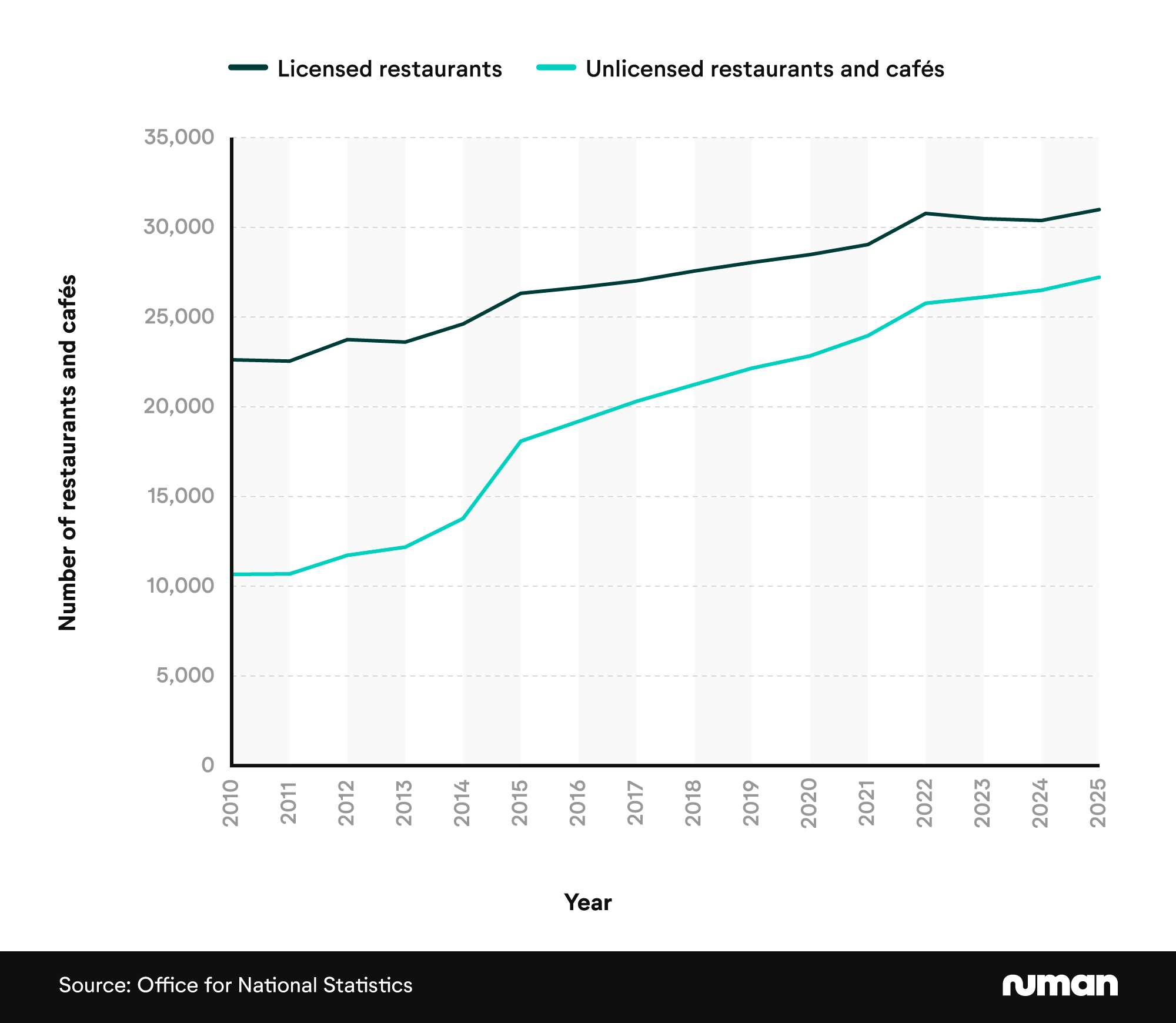
| Year | Licensed restaurants | Unlicensed restaurants |
|---|---|---|
| 2010 | 22,620 | 10,665 |
| 2011 | 22,545 | 10,685 |
| 2012 | 23,745 | 11,725 |
| 2013 | 23,605 | 12,180 |
| 2014 | 24,615 | 13,775 |
| 2015 | 26,325 | 18,085 |
| 2016 | 26,645 | 19,190 |
| 2017 | 27,020 | 20,305 |
| 2018 | 27,565 | 21,235 |
| 2019 | 28,045 | 22,155 |
| 2020 | 28,480 | 22,835 |
| 2021 | 29,040 | 23,960 |
| 2022 | 30,775 | 25,770 |
| 2023 | 30,485 | 26,110 |
| 2024 | 30,380 | 26,495 |
| 2025 | 30,990 | 27,220 |
UK food production, import, and export statistics
Number of UK food manufacturers
UK food production statistics indicate that, as of 2025, there are 20,095 food manufacturers in the UK.
The majority of these are unregistered businesses with no employees, which account for 53.05% of all UK food manufacturers.
 "Food stats 17")
Number of UK food manufacturers by employee size band
(Source: Department for Business & Trade)
The largest food manufacturers, those with 500 or more employees, account for just 0.65% of the UK’s total food manufacturing landscape.
| Employee size band | Number of food manufacturers |
|---|---|
| All businesses | 20,095 |
| With no employees (unregistered) | 10,660 |
| With no employees (registered) | 2,685 |
| 1 | 270 |
| 2 to 4 | 2,240 |
| 5 to 9 | 1,400 |
| 10 to 19 | 1,055 |
| 20 to 49 | 865 |
| 50 to 99 | 365 |
| 100 to 199 | 235 |
| 200 to 249 | 65 |
| 250 to 499 | 125 |
| 500 or more | 130 |
Value of food imports to the UK
In 2024, the UK imported £53.152 billion worth of food. The majority of this was made up by fruits and vegetables, which accounted for £14.449 billion, 27.18% of the UK’s food imports.
Total import value of trade in food in real terms (£ millions)
(Source: Department for Environment, Food & Rural Affairs)
In 2015, the UK imported £51.889 billion worth of food, meaning the total value of food imports per year has increased by 2.43% over the past decade.
| Category | 2015 | 2016 | 2017 | 2018 | 2019 | 2020 | 2021 | 2022 | 2023 | 2024 |
|---|---|---|---|---|---|---|---|---|---|---|
| Meat & meat preparations | 10,154 | 10,887 | 10,648 | 11,114 | 10,250 | 9,327 | 8,647 | 9,117 | 7,838 | 8,462 |
| Dairy & birds' eggs | 4,329 | 4,398 | 4,672 | 4,786 | 4,640 | 4,788 | 4,114 | 4,096 | 3,913 | 4,226 |
| Fish & fish preparations | 3,741 | 4,204 | 4,087 | 3,868 | 3,982 | 3,939 | 3,994 | 3,806 | 3,271 | 3,450 |
| Cereals & cereal preparations | 5,073 | 5,041 | 5,423 | 5,850 | 6,056 | 6,133 | 5,756 | 6,863 | 6,105 | 6,974 |
| Fruit and Vegetables | 12,592 | 13,173 | 13,505 | 13,685 | 13,846 | 13,652 | 12,466 | 13,225 | 12,853 | 14,449 |
| Sugar & sugar preparations | 2,292 | 2,132 | 2,128 | 1,917 | 1,924 | 1,828 | 2,012 | 1,913 | 2,003 | 1,835 |
| Coffee, tea, cocoa, spices, etc. | 5,002 | 5,261 | 5,289 | 5,464 | 5,600 | 5,787 | 5,422 | 5,805 | 5,298 | 6,005 |
| Miscellaneous edible prep. | 5,570 | 5,737 | 5,095 | 5,400 | 5,699 | 6,053 | 5,456 | 5,177 | 4,457 | 4,572 |
| Oil seeds & oleaginous fruits | 608 | 489 | 646 | 580 | 595 | 774 | 962 | 1,217 | 982 | 1,026 |
| Oils & fats | 2,528 | 2,634 | 2,967 | 2,745 | 2,613 | 2,542 | 2,143 | 2,884 | 2,210 | 2,153 |
Value of food and beverage exports from the UK
Conversely, in 2024, the UK exported £15.156 billion worth of food. This indicates that the UK exports 71.46% less food than it imports.
The majority of the UK’s food exports fall under the category of miscellaneous edible preparations (a broad category of processed foods which aren’t otherwise classified), which accounted for 16.96% of the total exports in 2024.
The value of the UK’s food exports has fallen by 6.73% in the past decade, from £16.250 billion in 2015 to £15.156 billion in 2024.
(Source: Department for Environment, Food & Rural Affairs)
Sources
https://yougov.co.uk/topics/society/trackers/how-healthy-brits-say-their-eating-habits-are
https://www.numan.com/numan-news/understanding-food-noise
https://yougov.co.uk/topics/consumer/trackers/how-brits-feel-about-fast-food-chains
https://yougov.co.uk/ratings/consumer/popularity/dining-brands/all
https://yougov.co.uk/topics/consumer/trackers/how-often-brits-buy-food-and-drink-at-shops
https://www.statista.com/statistics/1182077/free-school-meals-uk/
https://researchbriefings.files.parliament.uk/documents/CBP-9209/CBP-9209.pdf
https://geolytix.com/blog/supermarket-retail-points/
https://www.nomisweb.co.uk/query/construct/summary.asp?mode=construct&version=0&dataset=142
https://worldpopulationreview.com/country-rankings/vegetarianism-by-country
https://worldpopulationreview.com/country-rankings/veganism-by-country
Methodology
Numan conducted a study into food environments, analysis of food-related statistics, obesity metrics, and societal factors across local authorities in the UK.
These metrics are as follows:
Deprivation index for local authorities
Obesity diagnosis data
Mortality rates
Physical activity data
Number of takeaways
All collected data was cleaned and merged using local authority codes where available, and local authority names for metrics without codes.
This data was collected to determine the correlation between the prevalence of takeaway restaurants, fitness participation, and obesity rates across local authorities in the UK.
Updated: